

Star Wars: Episode IV – A New Hope opened on May 25, 1977, written and directed by George Lucas, produced by Gary Kurtz, with a score by John Williams that did as much to define the movie’s identity as anything on screen. A desert-planet farmhand named Luke Skywalker, played by Mark Hamill, gets pulled into a galactic rebellion after a droid hides a stolen set of plans inside its memory banks. He falls in with an aging hermit named Obi-Wan Kenobi, played by Alec Guinness, a smuggler named Han Solo, played by Harrison Ford, and a captured rebel leader named Princess Leia, played by Carrie Fisher.
Standing against them is Grand Moff Tarkin, played by Peter Cushing, and his enforcer, Darth Vader. The plot is simple enough to draw on a napkin. Everything interesting happens in how it’s executed.

Watch it again now, decades and ten more films removed from its original release, and what actually stands out isn’t the mythology, it’s the grime on everything. Lucas built a used universe: ships with dents, droids that get kicked around and cursed at, a smuggler’s ship held together by patches nobody bothered to paint over. Before this movie, science fiction on screen mostly looked sterile, chrome surfaces and clean white corridors. Lucas made the future look lived-in, and that single choice ended up shaping most of what came after it.
The cast carries a weight that’s easy to underrate now that these actors are cultural fixtures. Hamill plays Luke’s restlessness without tipping into whining, which is a harder needle to thread than it looks. Ford turns what could have been a stock rogue into someone genuinely funny, dry in a way that reads as real rather than scripted. Fisher gives Leia an authority that has nothing to do with being rescued, sharp-tongued from the moment she opens her mouth.
And Guinness, who reportedly had little patience for the material at the time, still gives Obi-Wan a stillness that holds the whole picture together whenever he’s on screen. Cushing, working with a fraction of the screen time, makes Tarkin feel more dangerous than any of the film’s more theatrical villains, precisely because he’s calm about it.
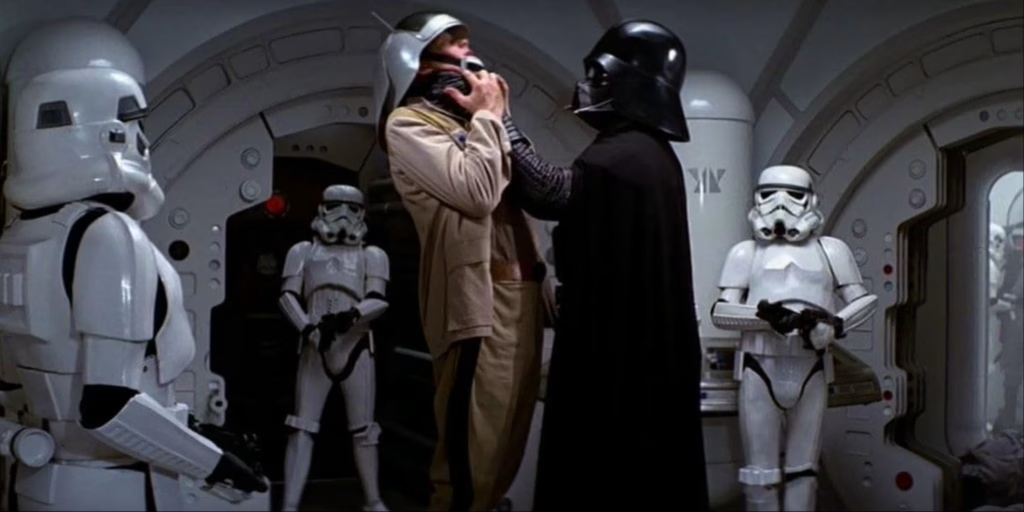
The pacing has aged better than most films from the era. Lucas keeps the plot moving through a series of escapes and near-misses rather than long stretches of exposition, and the effects, built largely by hand with models and motion-control cameras rather than anything digital, hold up because they were built to look physical in the first place. The Death Star trench run in the final act still works as pure tension, cross-cut editing doing most of the labor, Williams’s score pushing the pace without ever overwhelming it.
Where it shows its age is in the dialogue, occasionally clunky, occasionally over-explained, and in a supporting cast that exists mostly to move the plot rather than register as people. But none of that undercuts what the film actually set out to do. It wanted to feel like the middle chapter of a story that had already been going on for a while, dropped into a used, worn-out corner of a much bigger universe. It succeeded completely, which is part of why an entire industry spent the next two decades trying to copy it.
Still one of the most influential pieces of American filmmaking, and still, all these years later, just a good time at the movies. Streaming now on Disney+.


