

Few filmmakers possess the audacity—or the artistry—of Quentin Tarantino. With Inglourious Basterds, his 2009 revisionist World War II epic, Tarantino doesn’t just challenge genre conventions. He sets them ablaze. Equal parts war film, spaghetti western, and pulp revenge fantasy, this is a cinematic symphony that dances between tension and absurdity, history and myth, with the swagger of a director who knows exactly what he’s doing—and how to make you watch, eyes wide and jaw slack.

Told in five stylized chapters, Inglourious Basterds opens with a masterclass in suspense. In a quiet French farmhouse, SS Colonel Hans Landa (Christoph Waltz) drinks milk, smiles politely, and methodically tears through the psyche of a dairy farmer suspected of hiding Jews. It’s a slow burn of a scene—twenty minutes of carefully layered dialogue that ends in a massacre, and in doing so, announces everything Tarantino intends to do in this film: take his time, toy with his audience, and then strike with ferocity.
The story soon diverges into several overlapping plots. One follows Lt. Aldo Raine (Brad Pitt), a Tennessee hillbilly with a throat scar and a vendetta, leading a Jewish-American guerrilla unit known as “The Basterds.” Their mission? Kill Nazis, scalp them, and become legends in the process. Another thread tracks Shosanna Dreyfus (Mélanie Laurent), the lone survivor of Landa’s farmhouse massacre, now living in Paris under an alias and running a cinema. When her theater is chosen to host a Nazi propaganda premiere attended by the Third Reich’s upper echelon, including Hitler himself, she plots a fiery revenge.
Meanwhile, the British mount their own infiltration mission, aided by German actress-turned-double-agent Bridget von Hammersmark (Diane Kruger). These storylines converge in one of the most explosive—and unapologetically fictional—climaxes in recent film history: the Nazi leadership burned alive in a theater set aflame with highly flammable nitrate film, all while a Jewish woman’s ghostly face is projected over the smoke, laughing as fascism turns to ash.
At the center of this glorious chaos is a rogue’s gallery of unforgettable characters. Chief among them is Christoph Waltz’s Hans Landa, a character as terrifying as he is charismatic. Waltz’s performance, which earned him an Academy Award, is a study in contradictions: charming yet cruel, affable yet deadly. Landa is not motivated by ideology but by ego and opportunity—a sociopath with impeccable manners. Every scene he inhabits crackles with unease, because he doesn’t need to raise a weapon; he just needs to speak.

Brad Pitt’s Aldo Raine is his foil: bombastic, brutal, and utterly transparent. Raine leans into the American mythos with tongue firmly in cheek. He’s a man who carves swastikas into foreheads not just to punish, but to brand his justice. Pitt plays him with the rugged charm of a pulp comic book hero, adding a layer of humor to the film’s darkness.
Mélanie Laurent’s Shosanna, by contrast, is subtle, seething, and poetic. As a character, she represents the moral core of the film. Her vengeance is not performed with bravado, but with cold, cinematic elegance. In one of the film’s most chilling moments, her pre-recorded message is projected over the screen as the theater burns, her eyes staring into the camera, declaring, “This is the face of Jewish vengeance.” It’s pure Tarantino—bold, visual, and unforgettable.
Diane Kruger’s Bridget von Hammersmark adds an element of espionage and elegance to the film’s middle chapters. Her presence is especially potent in the infamous tavern scene—a twenty-minute sequence that rivals the opening for sheer tension, culminating in a single slip of the hand and a cascade of bullets. Til Schweiger’s Hugo Stiglitz, though more minor, is a cult favorite—a former Nazi killer turned Basterd, his silence speaks volumes, his fury even more so.

Beneath the blood and bravado, Inglourious Basterds explores deeper themes. The film is, above all, about storytelling itself—how narrative can be a weapon. Shosanna’s final act isn’t just an explosion of violence; it’s the triumph of film over fascism. In Tarantino’s world, cinema doesn’t merely depict war—it wages it. The story also delves into performance and identity. Everyone is acting: spies pretending to be Nazis, soldiers posing as civilians, enemies wearing masks of civility. Language becomes both shield and sword, with accents and fluency literally determining who lives and who dies.
And then there’s the thorny question of morality. Tarantino doesn’t offer neat answers—only emotional truth. The Jewish soldiers aren’t noble heroes; they’re avenging angels, scalping and mutilating in ways that mirror the cruelty they fight against. There’s no pretension of realism here. The film knows what it is: a revenge fantasy. And in a cinematic universe where Hitler dies in a theater fire, that fantasy is disturbingly satisfying.
Stylistically, the film is peak Tarantino. Dialogue is his deadliest weapon, and he wields it like a maestro. Tension simmers for agonizing lengths before detonating into brief, brutal violence. The visuals are richly composed, often evoking comic panels, noir tableaux, or western standoffs. The soundtrack—ranging from Ennio Morricone-inspired instrumentals to David Bowie’s “Cat People”—is deliberately anachronistic, enhancing mood rather than period authenticity.
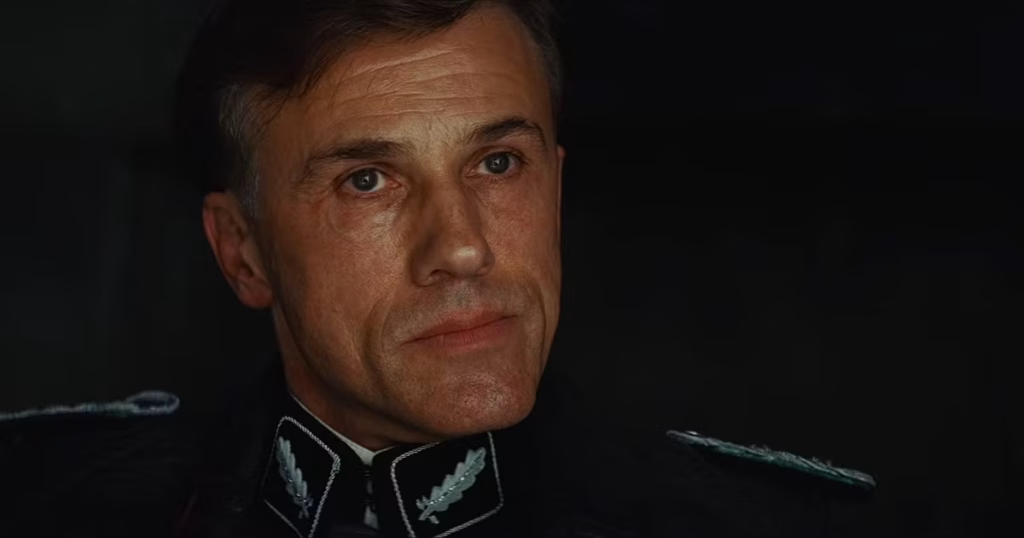
Colonel Hans Landa (Christoph Waltz)
“I love rumors! Facts can be so misleading, where rumors, true or false, are often revealing.”
Christoph Waltz’s portrayal of SS Colonel Hans Landa, aka “The Jew Hunter,” is nothing short of iconic. Landa is a polyglot, a manipulator, and a sociopath—an intellectual monster who derives pleasure from psychological dominance. Waltz’s performance earned him a well-deserved Oscar, and it’s easy to see why: Landa is charming and terrifying, often in the same breath. He’s one of Tarantino’s greatest villains, not because of physical strength, but because he weaponizes civility, wit, and cunning. Every scene he’s in is charged with unease.
Lt. Aldo Raine (Brad Pitt)
“We’re gonna be doin’ one thing, and one thing only… killin’ Nazis.”
Lt. Aldo Raine is the antithesis of subtlety. A backwoods Tennessee guerrilla leader with a scar across his throat and a drawl thicker than molasses, Raine leads the Basterds—a squad of Jewish-American soldiers tasked with scalping and terrorizing Nazis. Pitt plays him with just the right mix of deadpan seriousness and campy bravado. Raine is part satire, part folk hero—a character who knows he’s in a revenge movie and revels in it.
Shosanna Dreyfus (Mélanie Laurent)
“I have a message for Germany… you are all going to die.”
Shosanna is the emotional core of the film’s Jewish revenge arc. After surviving the massacre of her family by Landa, she reinvents herself as a Parisian cinema owner and plots a chilling, poetic vengeance. Laurent brings quiet strength and steely resolve to Shosanna. Her transformation from victim to executioner mirrors the film’s overall theme of reclaiming agency through violence
Inglourious Basterds is not just a war film. It’s a genre-defying masterpiece that dares to rewrite history with ink dipped in vengeance and celluloid. It challenges viewers to cheer for chaos, to question justice, and to fall in love with cinema all over again. Whether you watch it for the razor-sharp dialogue, the audacious performances, or the sheer spectacle of Tarantino’s vision, this film is proof that when art and anarchy collide, something unforgettable is born.
And as Lt. Raine says, with a grin as he carves a swastika into another Nazi skull: “I think this just might be my masterpiece.” He’s not wrong.


