
Forty-three years ago today, on September 21, 1983, a new David Mamet play opened in the smallest theater at London’s National Theatre. Seven men, two rooms, a lot of talking. Mamet had worked in a Chicago real estate office for a while in the late 1960s, and he wrote about it like someone who never quite got the smell of the place off his clothes. The play won the Pulitzer Prize for Drama the next year.
In 1992, James Foley made the movie version of Glengarry Glen Ross, and the cast still reads like a dare. Al Pacino, Jack Lemmon, Ed Harris, Alan Arkin, Kevin Spacey, Jonathan Pryce, and Alec Baldwin, who plays a character Mamet added for the film.

It opened in October 1992 and didn’t make its money back in theaters. By the standards of the men in the movie, that makes it a loser. Then people found it on video. It played on cable late at night for years, and at some point sales managers started showing the Baldwin scene at meetings to fire up their staff. Mamet wrote about a job that eats people alive, and a lot of the people doing that job decided it was a pep talk. I’m still not sure what to do with that.
The movie starts in the rain. The first stretch takes place at a Chinese restaurant near the office, with wet streets outside, red neon in the windows, and a row of pay phones along the wall. Lemmon’s Shelley Levene is on one of them, pitching a stranger, then calling about his daughter’s doctor, then pitching again. Harris’ Dave Moss is in the booth next to him, blowing a sale and blaming the leads. Two phone calls in, you already know these guys.
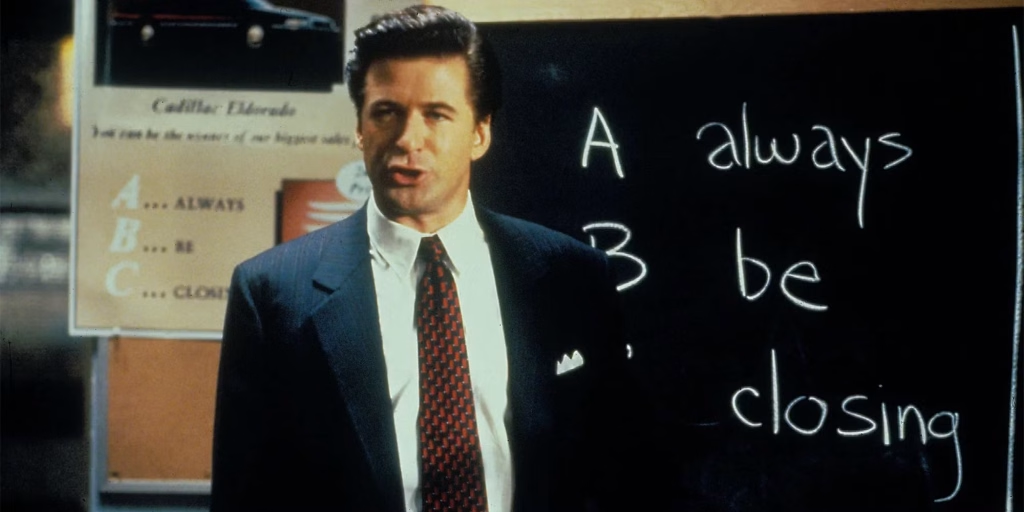
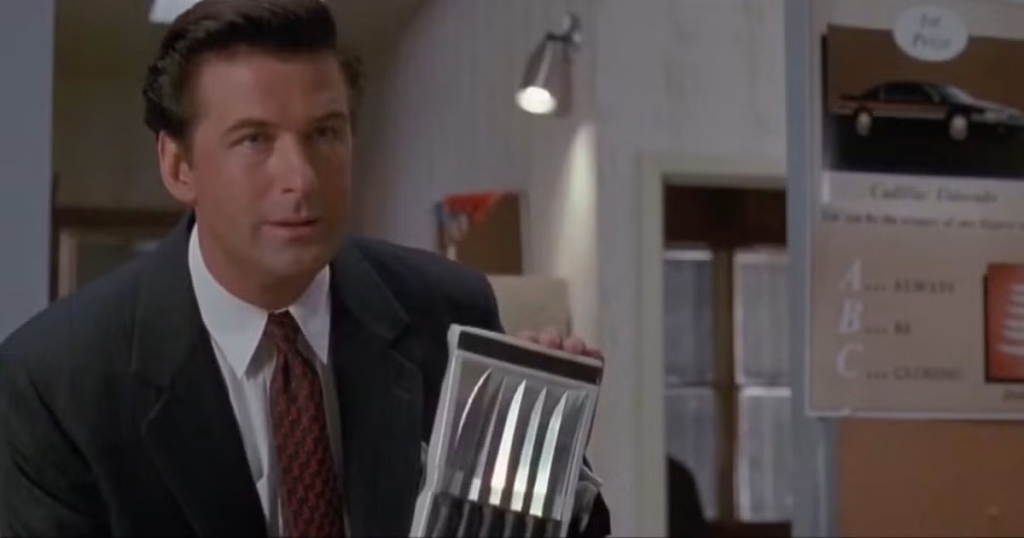
Then Blake shows up at the office. He’s sent by Mitch and Murray, the owners, who never appear. Baldwin plays him like a man who drove in from downtown just to enjoy this. He lays out the month’s contest. First prize is a Cadillac Eldorado. Second prize is a set of steak knives. Third prize, you’re fired. He writes three letters on a chalkboard, and at one point he pulls out a pair of brass balls and lets them swing.
Baldwin barely raises his voice for most of it, and that’s what makes it land. Blake runs on contempt, which sits colder than anger, and he talks with the ease of somebody who has done this in a lot of offices and liked it every time. He’s on screen for one scene. You feel him for the rest of the movie.
Pacino’s Ricky Roma misses the whole thing. He’s at the restaurant bar with James Lingk, a shy, lonely man Pryce plays with his shoulders pulled in, as if he’s used to being in the way. Roma talks to him about right and wrong, about fear, about how a man should live, and he keeps going so long you nearly forget there’s a sale in it. Near the end, a brochure comes out and slides across the table. It’s one of the best seductions in any movie from that decade, and nobody in it takes off a jacket.
That same year, Pacino won his Oscar for Scent of a Woman and was nominated for this one too. The Oscar went to the louder performance. I’d take this one. He stays calm for most of the movie, and when he finally lets Spacey’s office manager have it near the end, it feels like it’s been coming since the opening scene.
Arkin holds a lot of the movie together without anyone noticing. His George Aaronow agrees with whoever is talking so he never has to make up his own mind. Moss counts on that. Over drinks, he lays out a plan to break into the office, take the good Glengarry leads, and sell them to a competitor. Aaronow says no, he wants no part of it. Moss tells him it’s too late, he’s already in, because he listened. Watch Arkin’s face when that sinks in. It’s a small moment, and it might be the whole movie.
The next morning the office has been robbed. There’s glass on the floor, and a detective is questioning the men one by one in a back room. This is where Lemmon takes over. Levene walks in on a high, saying he closed eight units with a couple named Nyborg, and for a few minutes he gets to be the guy everyone used to call the Machine. He stands up straighter. His voice drops. He tells old war stories to anybody who’ll listen.
Lemmon won the top acting prize at the Venice Film Festival for this role, and the last twenty minutes show you why. Talking to Spacey’s John Williamson, Levene lets slip something only the man who broke in could know. You catch it first. A second later, you watch Lemmon realize it too. What comes after, the bargaining, the begging, the truth about the Nyborgs, is as hard to watch as anything he ever did, and he never plays for pity. Levene just keeps selling, right up until the only thing left to sell is himself.
Earlier that morning there’s a scene where Roma and Levene make up a two-man routine on the spot to keep Lingk from backing out of his deal, with Levene suddenly playing an important client in a hurry to catch a plane. It’s funny, in the way desperate people can be funny, and you get a glimpse of how good these two might have been together somewhere else. Williamson ruins it with one sentence, and what follows is the loudest the film ever gets.
Foley died in May 2025 at 71. He went on to direct episodes of House of Cards and two of the Fifty Shades movies, but nothing else he made comes close to this. He had the good sense to stay out of the way. With actors like these and words like Mamet’s, he mostly let them talk. The restaurant and the office feel like opposite ends of the same long, tired day, and it rains the whole time.
Seeing it again now, what stuck with me was how much of the talk is about the past. Levene keeps going back to the years when his name was at the top of the board. Roma describes the life he wants as though he’s already living it. Aaronow mostly wants to go home. The owners never show their faces, and neither does the land. Glengarry Highlands is a stack of names on index cards, and these men are ready to wreck each other to get them.
Thirty-four years later, I still think it’s the best American movie about going to work. Most of the credit goes to Lemmon, and that last walk into the back room.
Glengarry Glen Ross (1992) is rated R and runs about an hour and forty minutes. It is currently streaming on Prime Video.


