

There is a moment early in Pan’s Labyrinth when a girl walks into the woods with a book under her arm and finds a stone face lying in the dirt. It is missing an eye. She has the eye. It’s a small carved stone she picked up beside the road, and she fits it back into the socket, and the forest seems to take a breath. Twenty years later, that may still be the best introduction to a fairy tale ever put on film, because it tells you everything without saying a word. Something old has been broken here, and this child has been carrying the missing piece.
The film turned 20 this year, and it came back to theaters on October 9 in a new 4K presentation, with 3D and HDR versions, each overseen by Guillermo del Toro himself. So this is a good time to go back into the labyrinth and see whether it still holds. It does. If anything, it cuts deeper than it did in 2006.

Spain, summer of 1944. The Civil War has been over for five years, but nobody has told the mountains. Ofelia, played by Ivana Baquero, travels north with her mother, Carmen (Ariadna Gil), who is pregnant, sick and newly married to Captain Vidal (Sergi López). Vidal commands a Francoist outpost at an old mill, where his job is to hunt down the guerrillas still holding out in the forest. He wants one thing from his new wife, and that is a son born in his presence.
Mercedes, the housekeeper, is played by Maribel Verdú. She keeps Vidal’s house in order and his coffee hot, and she is quietly feeding the rebels in the hills, her brother among them. The village doctor is helping them too.
Behind the mill sits a ruined stone labyrinth. At its center waits a faun, an ancient, creaking creature played by Doug Jones, who tells Ofelia she is the lost princess of an underground kingdom. Her father, the king, has been waiting for her for centuries. To return, she must complete three tasks before the full moon. Each one is harder than the last, and each one asks her to choose between obeying and doing what’s right.

Most fantasy films treat the real world as the boring part, the gray stretch you sit through before the wardrobe opens. Del Toro does something braver. He makes the real world the nightmare and the fantasy world merely dangerous, and then he refuses to tell you which one is winning.
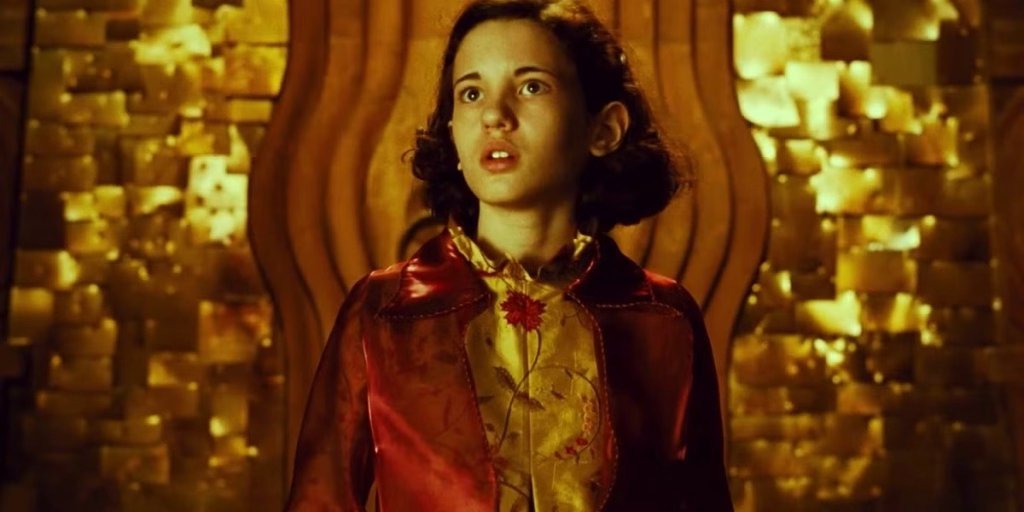
Look at how the film is lit. The mill is drowned in cold blues and wet greens, a world of rain, mud, gun oil and men in heavy coats. Underground, the light turns amber and gold, the color of candle flame and old honey. Guillermo Navarro, del Toro’s longtime cinematographer, won the Oscar for this, and you can see why in nearly every frame. The two palettes keep reaching for each other. Fireplace light leaks into Vidal’s study, and blue moonlight falls on the labyrinth. The two worlds are never as far apart as they seem.
Then there is Vidal, one of the great screen villains of this century, and Sergi López plays him without a trace of melodrama. Spanish producers reportedly doubted the casting, since López was known mostly for warmer roles, and del Toro insisted on him anyway. He was right. López gives the Captain the precision of a watchmaker. He shaves with care and polishes his boots. He winds his dead father’s pocket watch, the one with the cracked face, as if the act alone could hold time still. Then a farmer’s son is dragged in on suspicion of poaching, and Vidal beats him to death with a bottle, briskly, and goes back to his paperwork. The violence in this film is sudden and ugly and never glamorous. It arrives the way real cruelty does, between two ordinary moments.
Against him stands Ivana Baquero, a Barcelona girl not yet in her teens, carrying a film most adult actors would struggle to hold up. She never plays Ofelia as precious. There is stubbornness in her, a set to the jaw, a way of looking at the faun as if she has not quite decided to believe him. When she crawls into the roots of a dying fig tree to face a giant toad in the first task, she is terrified and she goes in anyway, and that turns out to be the whole character. Children in fairy tales are brave because they don’t yet know the cost. Ofelia knows it, and she keeps going.
Doug Jones, the great physical actor of modern fantasy, plays two roles here, and both of them are unforgettable. His faun is a marvel of shifting loyalties, all clicking joints and bark-colored skin, wheedling one moment and towering with rage the next. Jones learned his dialogue in Spanish so the eventual dubbing would sync perfectly with his mouth. You never quite trust the faun, and the film wants it that way.
His second role is the one that ended a lot of people’s peace of mind in 2006. The Pale Man sits motionless at the head of a banquet table piled with food, a sagging, eyeless figure with his eyeballs set on a plate in front of him. Ofelia has been told not to eat anything. She takes two grapes. The creature slowly lifts his hands, presses the eyes into his palms and raises them to his face to look at her. Nothing in recent horror has topped it. The banquet table echoes Vidal’s dinner party upstairs, where officers and local dignitaries eat well while the village goes on rations. Del Toro has put two monsters at the head of two tables and dared you to call one of them imaginary.
The quieter heroism belongs to Maribel Verdú’s Mercedes, who carries her terror in her shoulders and hides a kitchen knife in her apron. Her late scene with Vidal, which I won’t spell out here, is one of the most satisfying reckonings in modern film, and Verdú plays it with a fury that has been building for the entire running time. She also hums the film’s lullaby, a melody by composer Javier Navarrete that drifts through the score like a memory nobody can quite place. Navarrete earned an Oscar nomination for it. Once you’ve heard it, it stays with you for days.
There is a story behind the film that belongs alongside it. Del Toro fills notebooks with drawings and notes for years before he shoots anything, and he once left the notebook for this film in the back of a taxi. He believed the project was finished. The driver found it, understood what it was and went to real trouble to get it back to him. You could hardly invent a better origin for a film about the strange mercy of small acts.
The world first saw the finished film at Cannes in May 2006, where the standing ovation reportedly ran 22 minutes. It went on to win three Academy Awards, for cinematography, art direction and makeup, out of six nominations, and it made a fortune worldwide on a budget of about 13.5 million euros. More than the box office, though, it showed a generation of filmmakers that a fairy tale could carry the full weight of history and still sing.
About that ending. The film leaves room for two readings. You can see the final minutes as a child’s last escape from a world that failed her or as the truest thing that happens in the movie, and the film gives you every reason to believe both. Watch it twice and you may come down on a different side each time. That’s what fairy tales were before anyone softened them for the nursery.
Five stars out of five. Pan’s Labyrinth is a war film, a horror film and a fairy tale. It honors all three and cheats none of them, and two decades on it has not aged a day. The cruelty still shocks. The creatures still look handmade by someone who loved them. And a girl fitting a stone eye back into the forest still feels like the opening of a door.
Pan’s Labyrinth is rated R for graphic violence and language, and it is in Spanish with English subtitles. The 20th anniversary re-release from Fathom Entertainment and Cineverse is in select theaters now, so check Fathom’s listings for local showtimes. At home in the United States, the film is available to rent or buy digitally on Prime Video. As of this writing it is not streaming on any subscription service.


