

Milos Forman’s One Flew Over the Cuckoo’s Nest isn’t just the film of the year—it might be the film of the decade. This is a cinematic electroshock that jolts the viewer awake, pries open the bars of institutionalism, and reminds us how precious and fragile individual freedom really is.
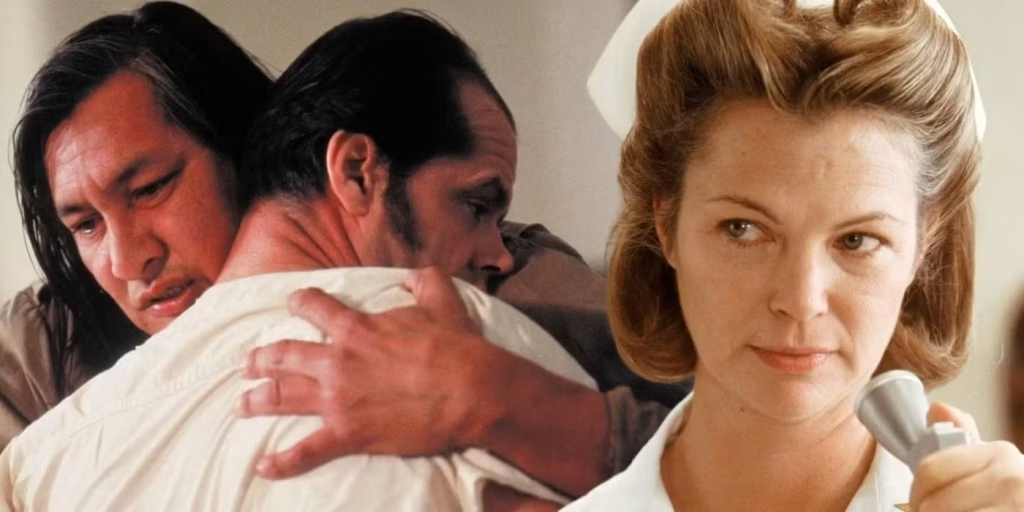
The film centers on Randle Patrick McMurphy (Jack Nicholson), a cocky, swaggering petty criminal who fakes insanity to escape prison labor by transferring to a state mental hospital. He believes he’s found a loophole, a softer gig—but what he discovers is a cold, sterile regime presided over by the quiet tyranny of Nurse Ratched (Louise Fletcher), a woman whose expression rarely changes and whose authority is absolute.
What begins as a lark becomes a slow-burning rebellion as McMurphy’s infectious spirit sparks change in the ward. He teaches the patients how to gamble, how to laugh, how to speak for themselves—and ultimately, how to live. But the price of revolution, as history has always shown us, is never cheap.

Character Studies: Titans in Conflict
R.P. McMurphy (Jack Nicholson):
Nicholson doesn’t just play McMurphy—he is McMurphy. With a wolfish grin, a cigarette always on hand, and eyes full of mischief and fire, he embodies the archetype of the American anti-hero. But beneath the swagger lies a man who genuinely cares, whose empathy for the broken men around him becomes his undoing. McMurphy isn’t insane—but he might be the only sane man in the room.
Nurse Ratched (Louise Fletcher):
In one of the most chilling performances in film history, Fletcher’s Nurse Ratched never raises her voice—she doesn’t need to. Her power lies in icy composure and institutional authority. She weaponizes routine, uses politeness as a cudgel, and eviscerates confidence with a single glance. She is Big Brother in a nurse’s uniform, a symbol of the system’s impersonal cruelty.
Chief Bromden (Will Sampson):
A towering figure both literally and metaphorically, the silent Native American becomes the soul of the film. Perceived as deaf and mute, his internal monologues reveal a deep awareness and sorrow. His final act—a heartbreaking mercy and symbolic liberation—is the film’s most cathartic moment.
Billy Bibbit (Brad Dourif):
A stammering young man suffocated by shame and infantilized by his mother and the institution, Billy is the most tragic figure. Dourif’s performance is delicate and devastating. He represents the vulnerable, those crushed under the weight of “care.”
“It’s not just the walls that imprison men. It’s the silence. The routine. The system that feeds on docility.”
– Anonymous Attendant, Ward B
What Forman has done here, with a masterful adaptation of Kesey’s novel, is expose the broader machinery of repression masquerading as sanity. The hospital becomes a metaphor for all systems that value order over humanity: schools, offices, bureaucracies, governments.
Mental illness is not the focus—power is. The real sickness lies not in the patients, but in the mechanisms that strip them of identity and agency. McMurphy’s defiance isn’t just personal—it’s political. When he steals a bus, takes the patients fishing, or challenges the therapeutic hierarchy, he becomes a stand-in for every outlier who’s ever been told to conform or be crushed.
Forman shoots the ward in tight, suffocating frames. The camera lingers on silence, on blank stares and sterile corridors. When McMurphy brings in life—music, light, chaos—it’s like watching color enter a black-and-white world. The pacing is slow but deliberate, echoing the institutional rhythm it critiques.
In post-Vietnam, post-Watergate America, One Flew Over the Cuckoo’s Nest arrives as a howl of protest. It belongs beside Easy Rider, Taxi Driver, and Network as part of a cinematic uprising against hypocrisy and authoritarianism. It challenges viewers to ask: what does it mean to be sane in a world that rewards compliance over compassion?
A blistering triumph of storytelling, performance, and social commentary. Watch it for Nicholson’s fury, Fletcher’s ice, and for the indelible reminder that freedom is always worth fighting for—even if it breaks you.
Directed by: Milos Forman
Starring: Jack Nicholson, Louise Fletcher, Brad Dourif, Will Sampson
Based on the novel by: Ken Kesey (1962)


