Every family has a Christmas that went sideways. The turkey burned, the lights blew a fuse, or an uncle explained cryptocurrency over pie. A Christmas Story knows this better than any holiday movie ever made, and it has been reminding us every December since 1983 that the best Christmas memories are usually the ones that went wrong.
The setup is about as simple as a movie gets. It’s the early 1940s in Hohman, Indiana, a made-up town modeled on Hammond, where the writer Jean Shepherd grew up. Nine-year-old Ralphie Parker wants one thing for Christmas, a Red Ryder BB gun, and every adult he asks gives him the same verdict. You’ll shoot your eye out.
His mother says it. His teacher says it in red pencil across his carefully written theme paper. Even the department store Santa says it, right before he sends Ralphie down the slide with a boot to the shoulder.
That’s the whole plot. The movie still finds 93 minutes of laughs in it, because Shepherd, who narrates as the grown-up Ralphie, remembers childhood the way it actually felt. Every small disaster seemed like the end of the world, and every grown-up seemed to be in on a conspiracy against you.
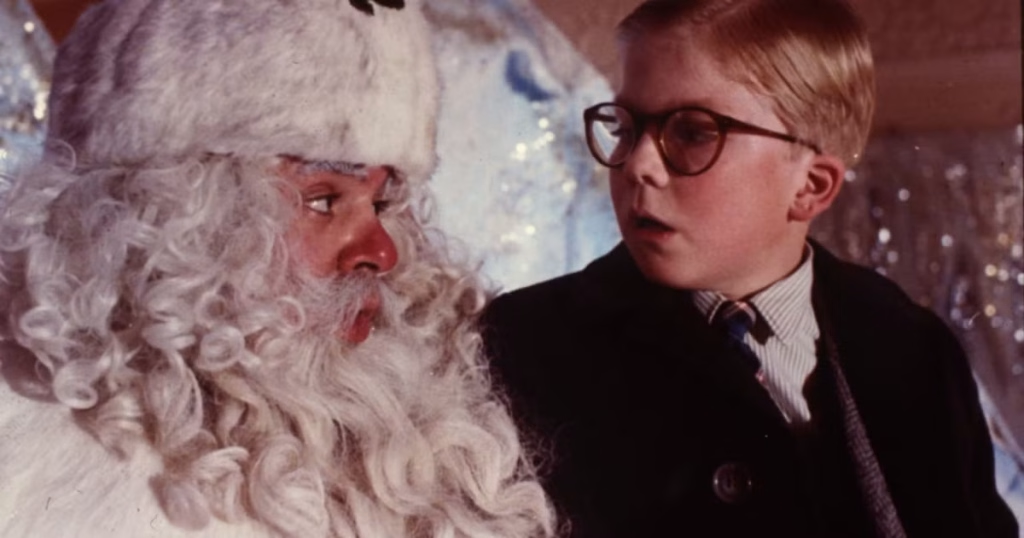
Peter Billingsley plays Ralphie with big glasses and a face that registers every hope and humiliation in real time. Watch him in Santa’s line, where his whole carefully rehearsed pitch evaporates and he agrees to a football instead. Anyone who ever froze in front of a mall Santa will feel that one in the stomach.
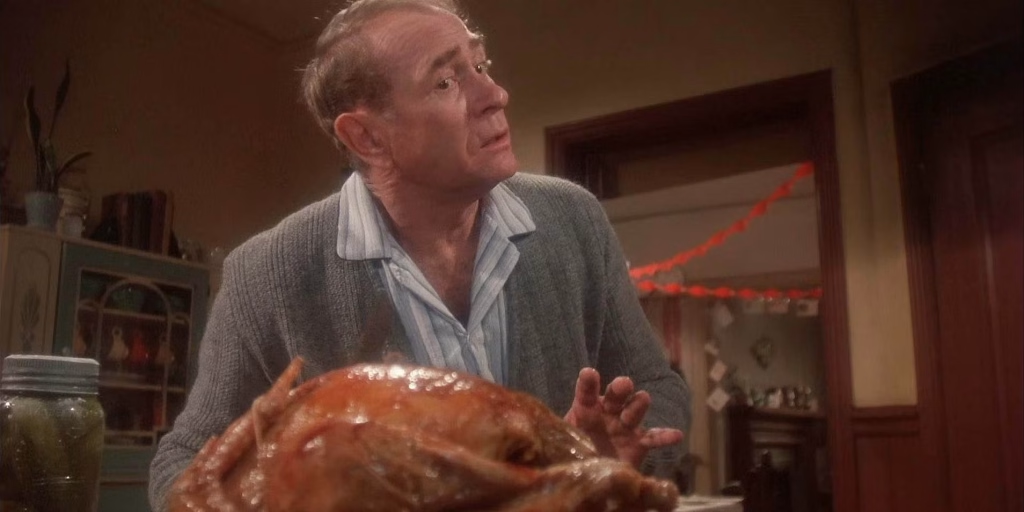
The real scene-stealer is Darren McGavin as the Old Man. He wages a nightly war against the furnace in the basement and swears at it in a creative string of syllables that never quite becomes an actual word. He also wins a contest prize he calls a major award, and it turns out to be a lamp shaped like a woman’s leg in a fishnet stocking.
The crate reads “Fragile,” which the Old Man pronounces fra-GEE-lay and decides must be Italian. He sets the lamp in the front window like a trophy. Melinda Dillon, as Ralphie’s mother, says nothing at all, and her expression does all the talking. The cold war over that lamp is one of the great marriage portraits in American comedy.
For a food writer, the movie is quietly a feast. Little brother Randy, played by Ian Petrella, refuses to eat his meatloaf and mashed potatoes until his mother coaxes him into eating like a piggy, face first into the plate. Ralphie spends weeks drinking cup after cup of Ovaltine to earn a secret decoder pin from his favorite radio show, only to decode a message that turns out to be a commercial. Every kid who ever mailed in cereal box tops knows that feeling.
Then there’s Christmas dinner. The Parkers’ turkey is roasted to a gleaming brown, and the neighbor’s pack of hounds bursts through the kitchen door and makes off with it. The family ends up at a Chinese restaurant, where the staff serves a whole roast duck, head and all, and the Old Man’s face is worth the price of the movie. Fair warning, though. The waiters’ carol in that scene leans on an ethnic joke that has aged poorly, and it plays rougher in 2026 than it did in 1983.
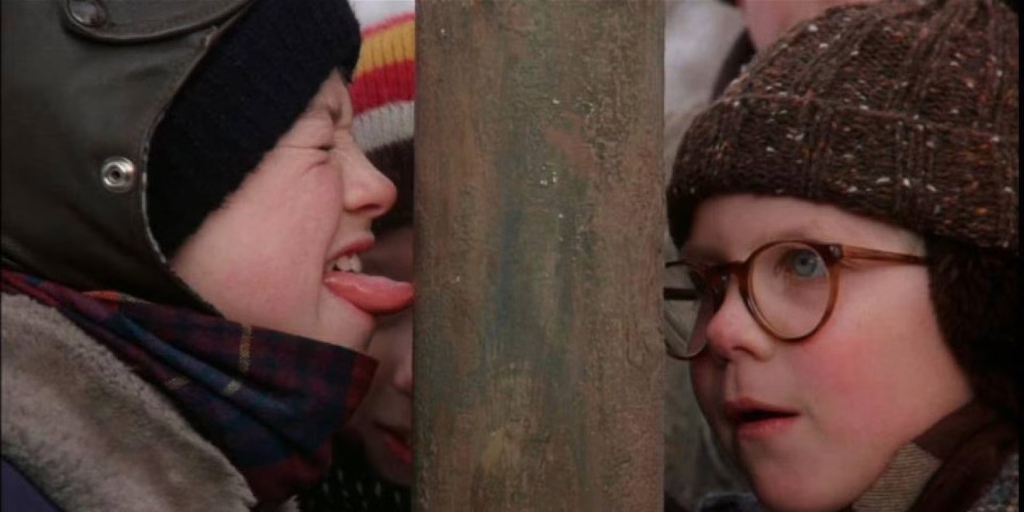
The schoolyard scenes hold up better. Ralphie’s pal Flick, played by Scott Schwartz, gets talked into licking a frozen flagpole on a triple-dog-dare, the most binding contract known to childhood. The crew used a hidden suction tube to make his tongue look stuck, which is more engineering than most holiday movies put into anything. Zack Ward plays Scut Farkus, the yellow-eyed bully who gets exactly what’s coming to him, and Tedde Moore is pitch-perfect as Miss Shields, the teacher who grades Ralphie’s dreams.
Here’s the surprise. The director, Bob Clark, made his name two years earlier with Porky’s, the raunchy teen comedy that set off a whole genre. Clark used that box office clout to make the gentle little memory piece he really wanted to make. He even turns up on screen as Swede, the neighbor who stops on the sidewalk to admire the leg lamp. Shepherd has a cameo too, as the grumpy man in the Santa line at the department store.
The movie opened on Nov. 18, 1983, and did modest business, earning about $20.8 million on a $3.3 million budget. Television made it a classic. TNT started running it for 24 hours straight on Christmas Eve in 1997, TBS took over the marathon in 2004, and both networks have run it together since 2014. In 2012, the Library of Congress added it to the National Film Registry, which makes the leg lamp officially a piece of American history.
The house where Ralphie’s family lived is in Cleveland’s Tremont neighborhood, at 3159 W. 11th St., and much of the film was shot in Cleveland, including the Santa scenes at the old Higbee’s department store downtown. The house reopened in 2006 restored to look exactly as it did on screen, leg lamp in the window, and today the House from A Christmas Story runs guided tours, with a museum across the street full of props from the film.
And yes, the gun is still for sale. Daisy still makes the Red Ryder, so somewhere this year another kid is making the same doomed pitch to a skeptical parent. Billingsley himself came back to the story as a grown-up Ralphie in A Christmas Story Christmas in 2022, but the original is the one worth your evening.
It’s a holiday movie with no angels and no miracles. It has one kid with one wish and a family that loves each other through a whole lot of nonsense. Watch it with someone who remembers their own leg lamp. Keep the dog away from the turkey. If you’re looking for more holiday viewing, CraveDFW’s take on White Christmas makes a fine double feature, and our Thanksgiving retro movie roundup covers the holiday that just wrapped up.


Leave a Reply