

Senegal is about as far west as you can go on the African continent before you hit the Atlantic. Dakar, the capital, is a port city — noisy, packed, ocean-salted, alive. People eat well there. They have for a long time. And the dish at the center of all of it has one of those names that stops people cold the first time they see it on a menu.
Thiéboudienne. Say it like this: cheb-oo-jen. In Wolof, the language most Senegalese people speak, it means rice and fish. Two words that don’t begin to describe what actually shows up at the table.
Here’s how it works. You take a whole firm-fleshed fish — usually grouper — and you cut slits into it, then stuff those slits with rof, a paste of parsley, garlic, hot pepper, and dried fermented mollusk. That fish goes into a pot with a tomato broth that’s already been cooking with onion, more garlic, and fermented fish for depth. Vegetables go in alongside it — cassava, cabbage, carrots, eggplant, sweet potato, whatever’s there. Everything cooks together until the fish is done, then the fish and vegetables come out and the rice goes in. The rice absorbs what’s left: the broth, the fat, all of it. At the bottom of the pot, a crust forms against the pan. That crust is called xoon, and it’s the part people argue over at the table.
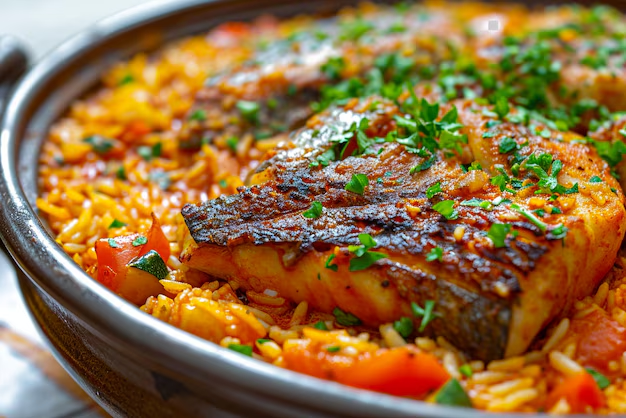
It comes out on a large communal tray. Rice on the bottom, fish and vegetables on top. You eat from the same tray. The flavor is smoky and deep and oceanic in a way that’s hard to place until you’ve had it. Jollof rice, which more people in this country know, is thought to have come from thiéboudienne — carried across West Africa and eventually into the American South by the Gullah people of coastal Georgia and the Carolinas, where it became red rice. Thiéboudienne is the ancestor of all of it.
Senegal itself is worth knowing a little about. It’s one of the more stable democracies in West Africa, with a coastline that stretches for miles and a culture built around something called teranga — hospitality, generosity, the instinct to feed people well. The food makes sense when you know that. It’s built for sharing.
Two places in DFW are doing this dish right.


Amie’s African Kitchen & Grill is at 4515 Village Fair Drive, Suite E4 in Dallas. Falah, who owns and runs the kitchen, is Wolof — she grew up with this food. The thiéboudienne here is the real thing. The menu also runs egusi, fufu, oxtails, jollof rice, and grilled fish and chicken, but thiéboudienne is what you came for. Monday 11 a.m. to 5 p.m., Tuesday closed, Wednesday through Sunday 11 a.m. to 8 p.m. Worth calling ahead at (214) 875-6668 — the kitchen runs deep and availability changes day to day.
West African Way is at 1405 Jupiter Road, Suite 116 in Plano. Chef Souleyman cooks Senegambian food — the tradition shared by Senegal and The Gambia — and his version of the dish appears on the menu as tchiep, the Gambian spelling. Same dish, same technique, same smoky bottom rice. The dibi chicken and domada, a peanut stew, are both worth ordering on the same visit. Everything comes out of a scratch kitchen, so on a busy night, call ahead: (972) 424-2634. Open Monday through Thursday noon to 10 p.m., Friday 4:30 to 11 p.m., Saturday noon to 11 p.m., Sunday noon to 10 p.m.
Go find this dish. It’s been around for centuries and it deserves more attention in Dallas than it’s getting.


