
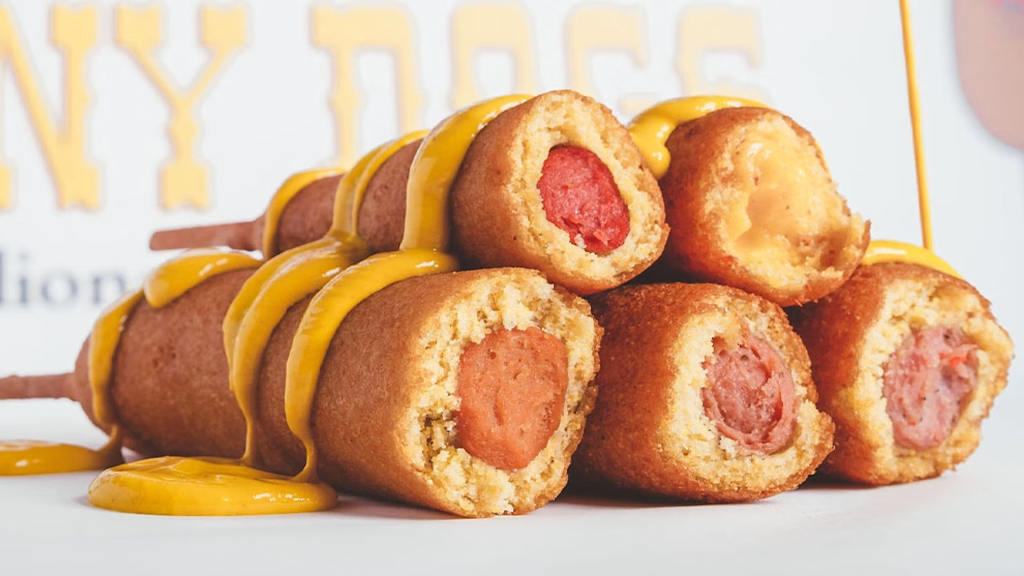
Every year around this time, something starts happening to people who grew up in Dallas. They smell a deep fryer that isn’t there yet, or they catch themselves thinking about mustard, and they realize the State Fair is close. A lot of that feeling traces back to one family and one stick of fried dough at Fletcher’s, and the Fair opens next Friday, September 25, so this is as good a week as any to tell the whole story.
It starts in 1938, with two brothers who weren’t cooks at all. Neil and Carl Fletcher were vaudeville performers, sixth-generation showmen who’d spent years touring with a family act called the Madcap Players and performing at Fair Park itself in a show called “The Drunkard.” As that career wound down, fair officials offered them a food booth. Neil later told the Dallas Morning News how the idea came together: “We said, ‘Sure.’ Then, over a bottle of bourbon, we tried to figure out what we could sell there.”

What they landed on was a memory. Neil recalled a baker on Oak Lawn Avenue who baked hot dogs into cornmeal, shaped like little ears of corn. It tasted fine, but it was slow and awkward to make. The brothers wondered what would happen if they skipped the baking, put the hot dog on a stick, battered it, and fried the whole thing instead. It took roughly four years of testing to get there. Carl and Neil worked to find a corn batter that would actually stick to the meat and taste good doing it, then learned to watch the fryer closely enough to avoid what they called a “yellow belly,” their term for an undercooked dog.
By the time they debuted the corny dog at the 1942 State Fair, they’d tried out names like K-9, Brown Bomber, and French Fried Hot Dog before Corny Dog stuck. Sales were slow at first. They started cutting the dogs in half and handing out free bites just to get people to try it. It worked. By the end of that first fair, the brothers had made about $8,000, worth well over $100,000 today.
Neil and Carl ran the business until they died, and in 1988 it passed to Neil’s son, Neil Jr., known to everyone as Skip. Skip was a commercial airline pilot and a Sinatra-obsessed crooner in his off hours, and when he retired from flying in 1982, he and his wife, G.G., started opening brick-and-mortar Fletcher’s locations around the state. By the mid-1980s, the family had 52 of them, some as far off as Arizona.

Then came the Texas oil bust, and it took the restaurants down with it. After a failed attempt to downsize, the company filed for bankruptcy in 1990, and a bankruptcy trustee sold off the Fletcher’s name and trademark to State Fair Foods. The family kept the right to sell corny dogs under their own name inside Fair Park and at one Dallas golf tournament, but nowhere else. For the next few decades, that arrangement mostly held, the fair business stayed strong, and the Fletchers kept dipping dogs every fall.
Skip died in 2017, and it’s what happened next that turned into the strangest chapter in corny dog history. G.G. became majority owner, and within a couple of years, Skip’s granddaughter Jace, who’d grown close to him before his death, launched her own corn-dog venture with her mother, Vic. They called it Fletch. G.G. found out about it from a state fair PR rep who congratulated her on the new venture, and she had to explain she had no idea what the rep was talking about. A lunch meant to smooth things over didn’t hold, and in 2019, Fletcher’s Original Corny Dogs filed a trademark lawsuit against Fletch. A judge ordered Jace and Vic to stop using the name while the case played out, and their planned September 2019 restaurant opening got delayed into January 2020 under a placeholder name: CornDog with No Name. The two sides eventually reached a private settlement, and the placeholder name became permanent. It’s still open in Dallas today, serving things like a corn dog rolled in bacon and one dipped in gold. Jace has said she’s made peace with how it all went. “There’s plenty of appetite for corn dogs,” she told Texas Monthly in 2021, and by most accounts, she’s right.
The pandemic hit the main business hard, since the fair, their biggest source of income by far, shut down entirely in 2020. The family responded by putting a food truck on the road that April, then ran more than a hundred pop-up events before the year was out. Partnerships followed with the chicken chain Golden Chick and the shipping company Goldbelly, which now sends Fletcher’s corny dogs anywhere in the country.
Today the business runs through the third generation. Skip and G.G.’s kids, Amber and Aaron, handle daily operations alongside their cousin William, and the family still shows up in force every fall, running seven stands across Fair Park through all 24 days of the fair. Some staffers have worked those booths for close to fifty years, longer than some of the Fletchers running them have been alive. Every corny dog is still hand-dipped, batter made from Neil’s original 1942 recipe, untouched since. In good years, the family sells more than half a million of them in one 24-day run, going through some 1,500 gallons of mustard and 800 gallons of ketchup in the process. Ketchup only made the menu in 1994, after enough customers demanded it. The family’s official stance hasn’t changed: real Fletcher’s people use mustard.

Beyond the Original Corny Dog, the current lineup includes a Jalapeño and Cheese Dog, a turkey Bird Dog, a Veggie Dog, a Cheezy Pup, and Make Mine Texan, an all-beef-and-brisket-blend version for people who want the classic with a little more Texas in it. This year’s addition skips the hot dog altogether: a Chocolate Corny Dog, fried dough served hot under powdered sugar and chocolate sauce, no meat, no stick pretending to be savory. It won Best Taste – Sweet at this year’s Big Tex Choice Awards, and Fletcher’s is selling it for $7. For 2026, the whole menu is staying under $10 a plate, part of a broader push by the fair itself to bring admission and parking costs down this year.
None of that history matters much the moment you’re actually holding one. The shell cracks first, sending up a little curl of steam, and under it the dog is hot enough to make you regret biting in too fast. It tastes like nothing else at the fair, and it tastes, more than anything, like the fair itself. Eighty-four years after two out-of-work vaudeville performers argued over a bottle of bourbon about what to sell out of a food booth, that first bite still works exactly the way they built it to.


