
Rear Window (1954) — Directed by Alfred Hitchcock. Starring James Stewart, Grace Kelly, Thelma Ritter, Wendell Corey, Raymond Burr. 112 minutes. Rated PG.
Alfred Hitchcock made films that asked you to be uncomfortable with yourself, and Rear Window is the most honest of them all about why. There is no monster in this film, no thunderstorm, no castle on a hill. There is only a window, a courtyard, a man in a wheelchair, and the oldest of human impulses: the need to watch other people without being watched back. By the time the film is over, Hitchcock has made you complicit in that impulse and then made you answer for it. That is the genius.
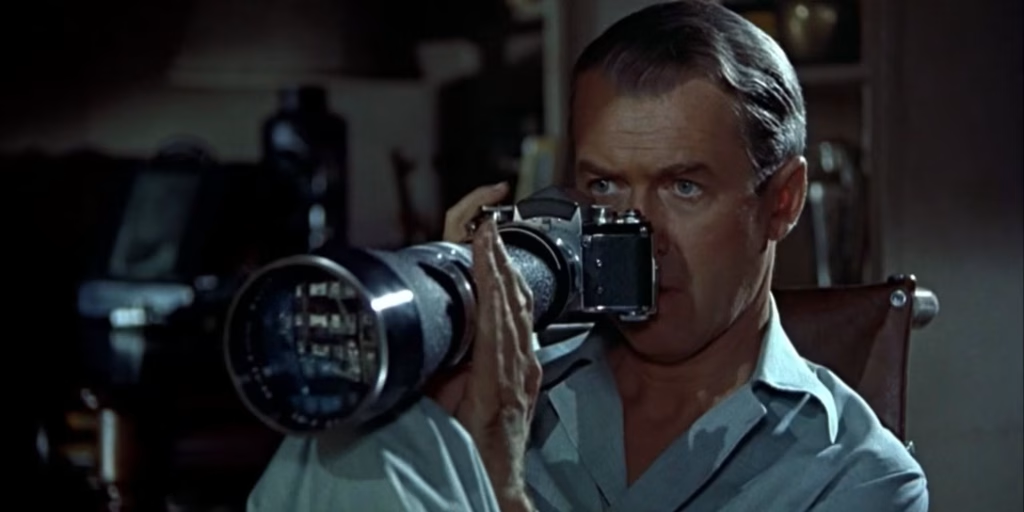
The premise is deceptive in its simplicity. L.B. “Jeff” Jefferies — played by James Stewart in what may be the most psychologically complex performance of his career — is a globetrotting news photographer confined to his Manhattan apartment with a broken leg during a sweltering New York summer. He has a telephoto lens, a pair of binoculars, and nothing but time. His rear window overlooks a courtyard populated by a cross-section of human longing: Miss Lonelyhearts, who sets dinner for two and eats alone; Miss Torso, who dances in her apartment for an audience she doesn’t know she has; the newlyweds who start with the blinds down and gradually open them to the world; the childless couple who lower their dog to the courtyard in a basket every morning. And then there are the Thorwalds — a bickering husband and bedridden wife — and one day, Mrs. Thorwald disappears.
What Hitchcock understood, and what makes Rear Window something more than a thriller, is that Jeff is not an innocent bystander who stumbles upon a crime. He is a voyeur who finds a crime that justifies what he was already doing. Jeff is the type of man who looks at the world through a lens rather than living in it. His girlfriend Grace Kelly, playing Lisa Fremont with a luminous intelligence that the film initially seems to undervalue, wants to marry him. He resists. He tells himself she is too glamorous for his life. What he means is that she is too real, too present, too much his equal. It is safer to watch the neighbors.

Grace Kelly is the performance the film takes its time earning. She arrives in a cloud of haute couture and expense, introduced in a close-up that Hitchcock frames with the reverence of a man who knows exactly what he is doing with a camera. The temptation is to see Lisa as decorative — and Kelly plays the role’s early scenes with the awareness that Jeff sees her that way too. The pivot comes when she decides to stop being watched and start watching herself, when she climbs through Thorwald’s window and becomes the most active person in the story. At that moment, the film’s argument shifts entirely. The man with the binoculars is helpless. The woman he thought was too refined for his dangerous life is the one in danger, doing the thing he only had the nerve to imagine.
Thelma Ritter, as Jeff’s insurance nurse Stella, provides the film’s moral voice and most of its wit. She is the only character who is honest about what Jeff is doing — she calls it window-peeping within the first ten minutes — and she says it with the weary expertise of a woman who has seen everything human beings are capable of and found most of it predictable. Her presence gives the film an earthy counterweight to Kelly’s elegance and Stewart’s increasingly obsessive intensity.
The single set is not a limitation. It is the argument. Hitchcock shot Rear Window almost entirely from inside Jeff’s apartment, the camera sharing his point of view, looking out at the courtyard the way he looks at it. This means we know only what he knows, see only what he sees, suspect only what he suspects. We are not watching a man watch his neighbors. We are watching alongside him, which makes us watch alongside him, which is the whole point. When the question of whether a murder actually occurred hangs in the air, the film is also asking whether we would have looked this hard if we weren’t hoping to see something terrible. The answer, for most of us watching, is probably yes.
The film opened in August 1954 to immediate acclaim and significant box office — made on a budget of approximately $1 million, it grossed more than $37 million in its initial release, an extraordinary figure for the time. It was screened in competition at the Venice Film Festival. Critics recognized it as a technical tour de force and something more. Bosley Crowther in the New York Times called it “a masterpiece of pure cinema.” The British Film Institute has ranked it among the greatest films ever made.
Why does it matter now? Because every argument the film makes has become more urgent, not less. Jeff watches his neighbors through a window with a telephoto lens. We watch strangers through phones and screens and social media feeds with the same mixture of boredom, curiosity, and low-grade desire for something to happen. We consume the private lives of people we do not know and tell ourselves it is connection. We catch glimpses of other people’s apartments, relationships, and choices and construct narratives around them. Hitchcock made this film in 1954 about a photographer with a camera and a broken leg. He was describing 2026 with an accuracy that should make us squirm, and does, if we are paying attention.
There is also the question of what the film thinks about men who watch women. Jeff watches Lisa without fully seeing her. He watches Miss Torso with interest. He has looked at the world through a lens for so long that the people in his viewfinder have become subjects rather than people — images to be composed rather than lives to be joined. Lisa breaks through that frame by the end, but it costs her something, and Hitchcock is not entirely sure the lesson takes. The final shot is not as reassuring as it first appears.
Rear Window is one of the five or six films I would take to that famous desert island without hesitation. It is the work of a director at the absolute height of his technical powers making something that is simultaneously a perfect thriller, a complex portrait of a troubled man, a feminist argument before the term had currency, and a meditation on spectatorship that reaches out of the screen and taps you on the shoulder. It is a film about watching. It has never stopped watching back.


