Dallas-Fort Worth is about to get loud. The next six weeks bring a run of arena rock, honky-tonk legends, and a few genuine bucket-list pairings, and the calendar only gets busier once the theaters and orchestras open their seasons behind them.
There is a moment in the first act of Bizet’s Carmenwhen the title character walks onto the stage, tosses a flower at a soldier she has barely glanced at, and walks away. No grand entrance. No trembling aria. Just that. And the soldier — and the audience — is already lost.
That soldier is Don José. He is decent, dutiful, engaged to a good woman back home. Within the hour he will have helped Carmen escape from custody, thrown away his career, and started down a road that ends with a knife outside a bullring. Carmen did not chase him. She never chases anyone. That is the whole point.
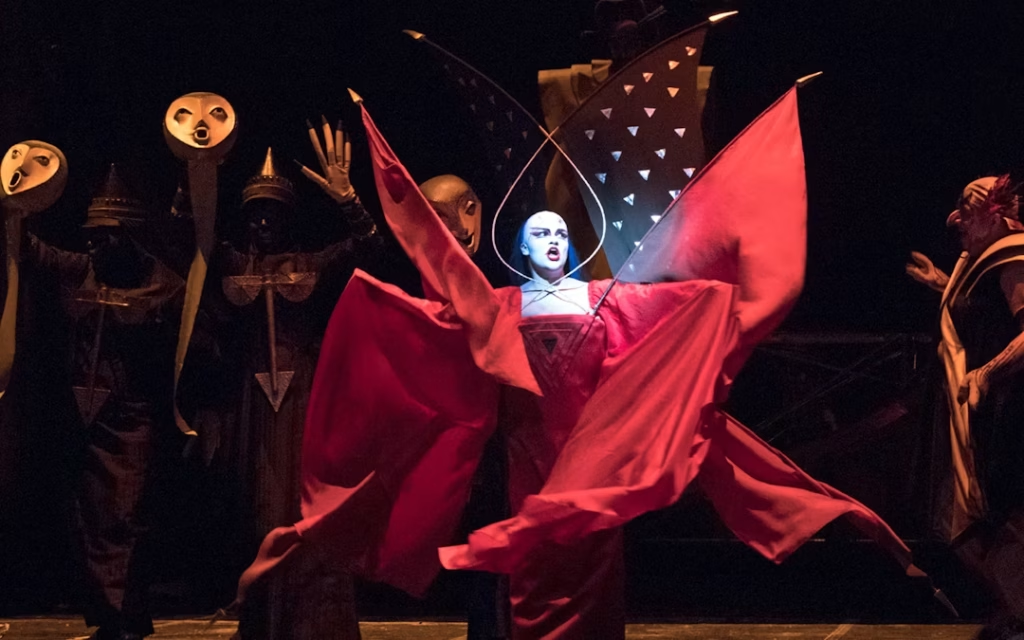
Opera’s The Queen of the Night from The Magic Flute is one of the most famous characters in opera. When the audience first meets her, she seems like a loving and worried mother. She asks the hero, Tamino, to rescue her daughter, Pamina, from a supposedly evil man named Sarastro. At first, she seems sympathetic and powerful, but as the story unfolds, it becomes clear that she is actually the villain. Sarastro is wise, calm, and good, while the Queen of the Night is driven by anger, revenge, and strong emotions. This shift in perception makes her a very interesting and dramatic character.
Violetta Valéry is the emotional center of La Traviata, and one of opera’s most human characters. At first glance she seems to have everything: wealth, beauty, and a glamorous social life in Paris. But Violetta is also a courtesan—admired in public, judged in private—and she understands that the world she lives in offers comfort without respect. On top of that, she is quietly dying of tuberculosis, a fact that gives her story a constant sense of urgency.
When it comes to opera characters who are energetic, humorous, and impossible to ignore, few can match Papageno. From Die Zauberflöte (The Magic Flute) by Wolfgang Amadeus Mozart, Papageno is the archetypal comic figure — a bird-catcher with a heart as big as his appetite for food, drink, and love. On stage, he bursts with playful energy, moving with physical comedy that rivals his vocal agility. Every scene he enters is filled with movement, gestures, and expressions that instantly draw the audience into his world.
Opera gives us kings, gods, and seducers. Rigolettogives us a man who knows the world is cruel—and believes he can protect what he loves from it. He can’t.
Giuseppe Verdi’s1851 masterpiece centers on Rigoletto, a court jester deformed in body and scorned in society. He survives by mocking the powerful, using cruelty as armor. Every insult reminds him he doesn’t belong—but at home, he is fiercely devoted to his daughter, Gilda. He hides her, shelters her, and convinces himself that ignorance equals safety. The love is real. The fear is genuine. The harm is inevitable.
In the world of opera, few characters are as immediately captivating and emotionally complex as Violetta Valéry from Verdi’s La Traviata. From the moment she steps onto the stage, she commands attention—not simply as a soprano role requiring vocal brilliance, but as a fully realized human being: charming, independent, passionate, and heartbreakingly vulnerable. Violetta is a socialite, a courtesan in Paris, yet she is written with layers that reveal courage, wit, and self-awareness, making her far more than a stock figure of melodrama.
Every great comedy needs someone who knows everyone, fixes everything, and stays three steps ahead. In opera, that person is Figaro. InThe Barber of Seville, he isn’t the romantic lead, but he is the reason the story moves at all. A barber by trade and a schemer by instinct, Figaro turns Count Almaviva’s impossible love problem into a fast-moving game of disguises, distractions, and perfectly timed interventions.