
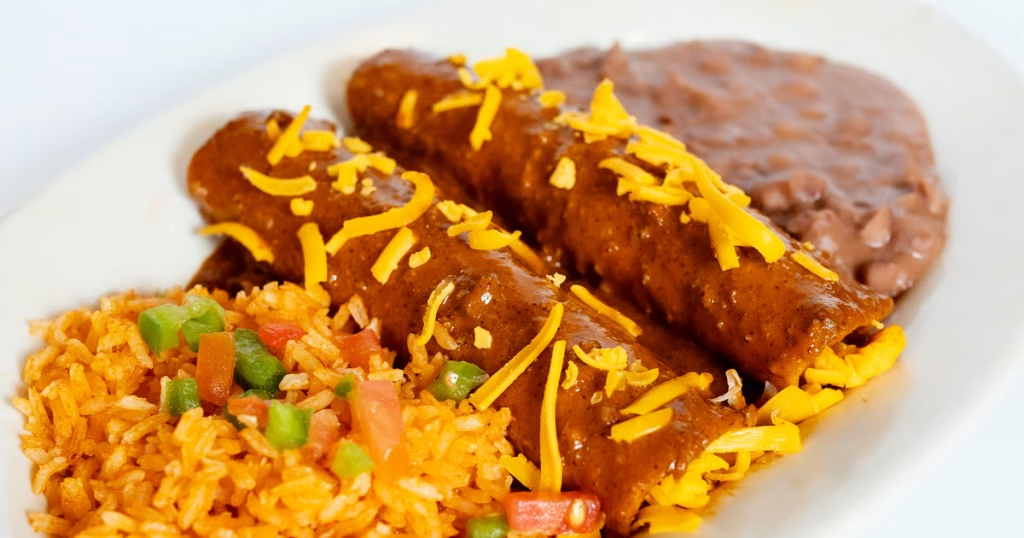
At some point in the last hundred years, someone decided that two enchiladas, a crispy taco, a scoop of rice, and a ladle of refried beans constituted a complete meal, put it on a plate, and charged you a fixed price for the whole thing. Half the country has been ordering that plate ever since without once asking where it came from. The answer is Texas, and the story is more interesting than the plate.
The combination plate as a format traces to San Antonio in 1900. A Chicago native named Otis M. Farnsworth opened a place called The Original Mexican Restaurant on Losoya Street and started offering a fixed-price assortment of Mexican dishes for fifteen cents. Male patrons were required to wear a jacket. FDR ate there — or at a Fort Worth copy of it — whenever he was in Texas visiting his son Elliott. The logic behind the combo plate was the same then as now: a few things from the menu, a starch, a bean, a price that made sense. It wasn’t culinary philosophy. It was practical hospitality.
Dallas got there through two families who between them shaped the flavor profile of an entire city.

Miguel Martínez opened the first Mexican restaurant in Dallas in 1918 at a place called Martinez Café — now El Fenix, still on Commerce Street, still serving the combination plate. In the beginning he offered only Anglo-American dishes, then started weaving in Mexican preparations and asking his guests what they thought. Their feedback built the menu. El Fenix became the template. The crowds came back.
In 1928, Adelaida “Mama” Cuéllar opened Cuéllar’s Café in Kaufman with the recipes she had carried from Mexico. Four of her sons moved to Dallas in 1940 and opened the first El Chico. By the 1950s both families had multiple locations, and the combination plate had become the default language of Dallas Tex-Mex. You didn’t order off the menu. You ordered the number. A crispy taco, two enchiladas — one cheese, one beef — rice, beans, and a cup of chili gravy over all of it. The plate was the same whether you were in Oak Cliff or East Dallas. That consistency was the whole point.
The combination plate in that 1950s form was defined by a handful of ingredients that had nothing to do with Mexico: yellow American cheese, canned tomatoes, chili powder from a jar, flour tortillas, and Velveeta. Food writer Diana Kennedy arrived on the scene in 1972 and declared war on all of it in her landmark book The Cuisines of Mexico. “Far too many people know Mexican food as a ‘mixed plate,'” she wrote, describing it with barely concealed contempt. Where, she asked, was the wonderful play of texture, color, and flavor? She had a point. She was also describing something that had its own internal logic, its own history, and its own devoted audience. The Tex-Mex combination plate survived Diana Kennedy just fine.
Mico Rodriguez refined the whole operation in 1991 when he opened the first Mi Cocina in the Preston Forest Shopping Center and started making combination plates with quality cheddar, fresh jalapeños, and cilantro instead of the ingredients that came in a can. The plate looked the same. It tasted like a different decade. Dallas noticed.
Now about Wednesday

If you grew up in San Antonio, you don’t need this explained. If you grew up in Dallas, you may have encountered the Wednesday enchilada at restaurants without knowing it came from somewhere specific. The tradition started in San Antonio public schools, probably in the 1920s and certainly by the 1930s — Bonham Elementary, one of the city’s oldest schools, had a hot lunch program that included Mexican food from its earliest days, with kids walking across the playground to the school janitor’s wife who served them chili, beans, and bread. By the 1950s, the San Antonio Independent School District had formalized it: Wednesday was enchilada day, every cafeteria, every school. Two cheese enchiladas, rice and beans, chocolate cake. Thirty-five cents.
What followed was the stuff of institutional legend. Attendance was measurably higher on Wednesdays than any other day of the week. Kids who normally brought lunch from home got in line. Parents showed up to eat with their children specifically on Wednesdays. One student broke his arm sprinting to the cafeteria, put his hand through the plate glass door trying to push it open — and still got in line before going to the nurse. The North East ISD in San Antonio still makes the enchiladas by hand to this day, rolling each one individually, smothering them in a house-made chili gravy thickened with a roux, and considers it the district’s flagship dish. A school cafeteria in Stockholm, Sweden, after discovering the recipe online, served it to their students. “Today we served enchilada,” they reported back online, “inspired by the amazing recipe.”
The Wednesday tradition spread north through Texas restaurants even where school cafeterias didn’t formally adopt it — Dallas schools, notably, were largely absent from Enchilada Wednesday as an institutional practice. But the restaurants picked it up. Midweek enchilada specials became the standard across Tex-Mex Dallas, and if you’ve spent any time here you know that Wednesday still carries a different energy at Mia’s, at El Fenix, at Joe T. Garcia’s, at any neighborhood spot that has been around long enough to have regulars who know what day it is.

The combination plate itself hasn’t changed much in a century. Two enchiladas. A taco. Rice and beans. Chili gravy over the top if you’re in Dallas. A basket of chips arriving before you order anything. It’s fifteen cents worth of logic dressed up and served a few hundred million times since Otis Farnsworth put it on the menu in San Antonio in 1900, and it will still be on the menu a hundred years from now. Some things work.
Where to order one in Dallas right now: El Fenix on Commerce Street, the original, established 1918. Mia’s Tex-Mex on Lemmon Avenue, where the beef enchiladas with chili gravy have their own following. Mi Cocina for the refined version. And on Wednesdays, anywhere that’s been open long enough to know what day it is.


