
Dallas has one of the most serious Korean dining corridors in Texas, centered on Royal Lane in the Asian Trade District but spreading well beyond it. The food is specific and regional and worth understanding before you order. Here are the dishes that matter most and where to find the best version of each.
Korean BBQ — Galbi and Samgyeopsal

Galbi are beef short ribs, cut thin across the bone and marinated in soy, garlic, sesame, and sugar. Samgyeopsal is pork belly, unmarinated, thick-sliced, cooked until the fat crisps. Both go on a tabletop grill and you wrap the cooked meat in lettuce with rice, fermented soybean paste, and whatever banchan you have on the table. The wrapping is not optional. It is the point. Koryo Kalbi at 2560 Royal Lane, Suite 105 has charcoal grills at every table, a dry-aging cabinet for the beef, and some of the best banchan in Dallas — sometimes three kinds of kimchi on the same table. The hot stone bowl bibimbap is worth ordering alongside the meat.
Sundubu Jjigae — Soft Tofu Stew
Sundubu jjigae is a red stew built on a pork or seafood broth, loaded with silken tofu that breaks apart in the spoon, clams, mushrooms, and zucchini, finished with an egg cracked in at the table. It arrives at a rolling boil in a stone pot and stays hot through the entire meal. The heat level is serious and the depth of the broth is what separates a good version from a great one. So Kong Dong Tofu at 2330 Royal Lane, Suite 300 is the room built entirely around this dish. Order it spicy. The banchan that comes with it — kimchi, spinach, dried seaweed — is restrained and correct.
Seolleongtang — Ox Bone Soup

Seolleongtang is what happens when ox bones simmer for twelve hours or more — the broth goes milky white from the collagen and marrow, with a clean, deep flavor that reads almost neutral until you season it yourself with salt, white pepper, and scallions. It comes with thin slices of beef and a bowl of rice on the side. Seasoning it at the table is expected and necessary. Doma Seolleongtang on Royal Lane is the Dallas address for this bowl. It is the top-rated Korean restaurant on Yelp in DFW and the seolleongtang is the reason.
Tteokbokki — Spicy Rice Cakes
Tteokbokki are cylindrical rice cakes simmered in a gochujang and anchovy broth until they absorb the sauce and turn glossy and chewy. The heat is persistent rather than sharp. Fish cakes and boiled eggs go in the pot. It reads like street food because it is — this is what you eat at a pojangmacha in Seoul at midnight. Damasita at 2564 Royal Lane does the galbisal version — prime rib cooked into the tteokbokki — which is the upgraded interpretation. Seoul Garden at 502 Royal Lane also runs a strong version of the original.
Bibimbap — Mixed Rice Bowl

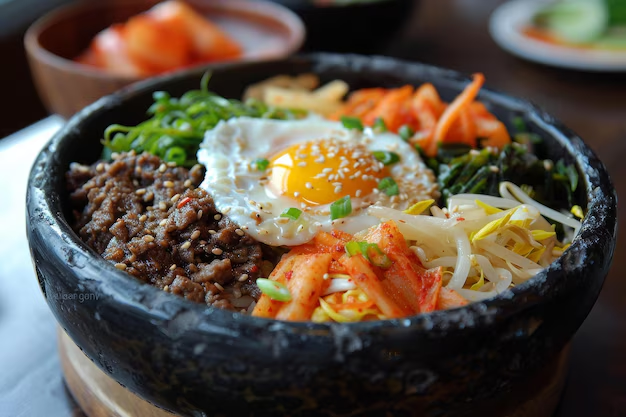
Bibimbap is rice in a stone bowl, topped with seasoned vegetables — spinach, bean sprouts, carrots, mushrooms, zucchini — plus a raw or fried egg and gochujang on the side. You mix everything together before eating. The stone bowl version, dolsot bibimbap, arrives crackling hot and forms a crust of scorched rice at the bottom that is the best part of the bowl. bbbop Seoul Kitchen at 2598 Royal Lane in Dallas and multiple DFW locations builds its entire identity around the rice bowl. The For Realz Bop is the straightforward bibimbap. The coconut curry bop and spicy chicken versions are the restaurant’s own voice. Both are worth ordering.
Korean Fried Chicken

Korean fried chicken is double-fried — the first fry cooks the meat, the second fry shatters the skin. The result is a crust that stays crispy longer than any American fried chicken technique produces. The two classic sauces are yangnyeom, a sticky-sweet gochujang glaze, and soy garlic, which is exactly what it sounds like. bbbop Seoul Kitchen handles the fried chicken alongside the rice bowls and the kimchi fries — curry ranch fries loaded with kimchi, cilantro, pickled jalapeños, and a runny egg — are the thing to order while the chicken comes out.
Japchae — Glass Noodles
Japchae is stir-fried sweet potato glass noodles — translucent, slightly chewy, with a mild sweetness — tossed with spinach, carrots, onion, and mushrooms in sesame oil and soy sauce, finished with thin strips of beef. It is often served at room temperature and works as a side or a main. The version at Damasita on Royal Lane is consistently cited as the best in Dallas — the noodles properly cooked, the sesame flavor present without overwhelming everything else.
Kimbap

Kimbap is often described as Korean sushi and it isn’t, but the confusion is understandable — it’s seasoned rice and fillings rolled in seaweed, sliced into rounds. The difference is in the seasoning: the rice uses sesame oil rather than vinegar, and the fillings run toward pickled vegetables, egg, crab stick, and bulgogi rather than raw fish. It is portable, cheap, and surprisingly filling. Damasita on Royal Lane is the Dallas address. The maeun chamchi kimbap — tuna with spicy mayo — and the bulgogi kimbap are both worth the drive. The kitchen closes at 6pm, so plan accordingly.
Jajangmyeon — Black Bean Noodles
Jajangmyeon is thick wheat noodles under a dark, fermented black bean paste sauce cooked with pork and vegetables. It is Chinese-Korean in origin — a dish that Korean-Chinese restaurants brought to Seoul in the 1800s and that Korea made its own. The sauce is savory and slightly sweet with a deep, almost smoky undertone. It is comfort food in the most direct sense. Gomonae on Royal Lane in the Asian Trade District is the room for this dish in Dallas.
Most of these restaurants are within a few blocks of each other on Royal Lane in the Asian Trade District on the north side of Dallas. Park once and eat your way through several of them. That is the right approach.


