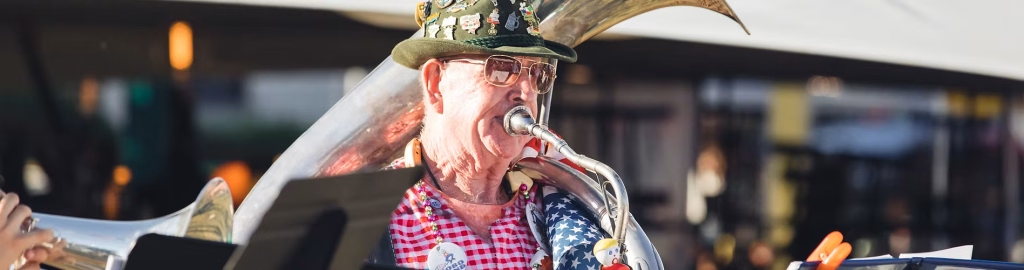
The tuba gets there first. Somewhere under a striped tent on Marktplatz, an oompah band finds its footing, and the sound rolls down Main Street past the limestone storefronts. By the time you reach the gate, the air smells like grilled sausage, and a few hundred strangers are getting ready to do the chicken dance together without a trace of embarrassment.
That is Oktoberfest in Fredericksburg, and this year it runs October 2 through 4.
The wind shows up before the mountains do. It comes off the Southern Patagonian Ice Field with nothing to slow it down, flattens the tall grass across the steppe, and leans on the car door hard enough that you have to push back. Then the clouds pull apart for a minute and the towers appear, three gray granite spires standing over Torres del Paine National Park, close enough that you forget how cold your hands are.
Naples in January is the reason people put up with Naples in August. Mid-seventies, no humidity, the Gulf flat and green, and a sunset every evening that empties the restaurants onto the sand for ten minutes.
That’s when the biggest resort on that stretch of beach reopens under a new name.
The blind goes up somewhere west of Edmonton and the window fills with fir trees running past at speed. Then the trees drop away and the eastern wall of the Rockies stands there in the early light, pink at the top, close enough to feel rude. Coffee in hand, half the dome car still asleep, nobody says anything for a while. That is the moment people pay for on VIA Rail‘s Canadian, and it arrives on the fourth morning, without warning, whether you were awake for it or not.
Every so often a city comes along that ruins you a little for other vacations. Charleston did that to me. It’s small enough to walk end to end in an afternoon, old enough that half the buildings predate the country, and stacked with restaurants at a density that makes no logical sense for a city this size. I went for four days planning to split my time between history and food. I came home having barely touched the history.
If Dallas ever needed a sister city for a long weekend that isn’t about theme parks or football, this is it.
The whistle sounds before you see the smoke. Then the smoke comes, curling up over farmland that Amish families have worked for generations, and a locomotive built for a different century pulls slowly into view. This is Strasburg, Pennsylvania, home to the oldest continuously operating railroad in the country, chartered in 1832. What happens over the following days is where the real trip lives.
A word of honesty before anything else: Strasburg Rail Road is not an overnight sleeper train. The signature excursion is a 45-minute, nine-mile round trip through 2,500 acres of Lancaster County farmland, out to Paradise, Pennsylvania, and back. There are no berths, no sleeping cars, nothing resembling the Orient Express. What Strasburg offers instead is something quieter and, in its own way, harder to replicate: a working piece of American railroading history, still running on steam, still passing through the same Amish countryside it always has. Built around three days, this is everything worth knowing before you go.
The name suggests a border town, sun-bleached and dusty, somewhere along the Rio Grande. Cafe Del Rio is actually about as far from the border as Texas gets, sitting deep in the Piney Woods of Lufkin, closer to Louisiana than to Mexico. The name misleads you before you’ve even walked in.
Some lakes ask to be admired. Lake Tahoe asks to be entered. Its water holds a clarity so complete that sunlight travels fifty, sometimes seventy feet down before it surrenders, casting the shallows in a turquoise that belongs more to the Caribbean than the Sierra, and the depths in a blue so dark it reads as bottomless. Granite peaks rise around the entire basin, holding their snow into June, framing the water like something meant to be approached slowly and left reluctantly. There is a stillness that settles over the surface in late afternoon, just before the light turns gold, that no photograph quite manages to hold onto. It has to be stood in.